NAPA Autotech
Northwest Auto Care Alliance is partnering with NAPA Autotech to bring you training.
NAPA AUTOTECH – Tech Updates
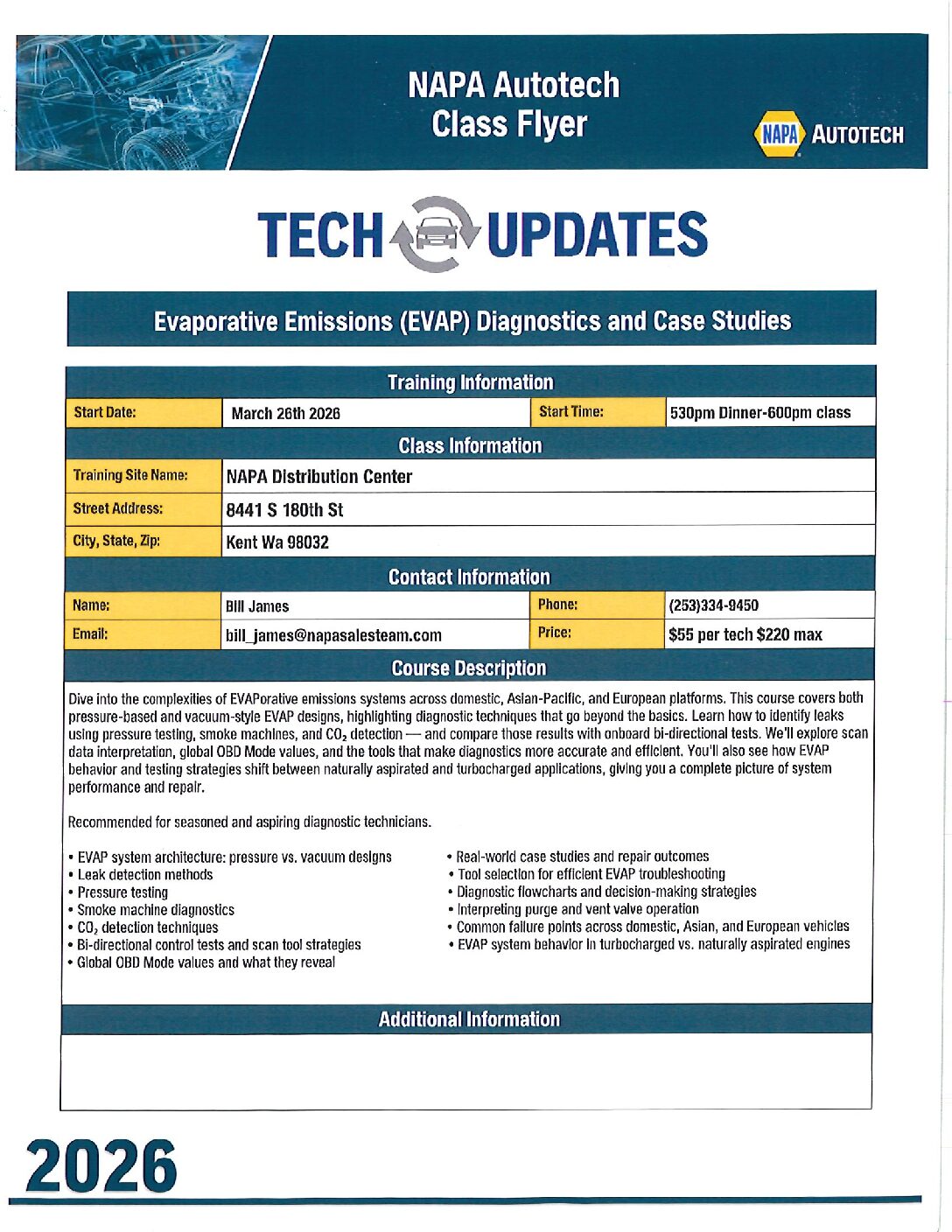
Title: Evaporative Emissions (EVAP) Diagnostics & Case Studies
Date: March 26th, 2026
Time: 5:30 pm – Dinner, 6:00 pm Class
Location: NAPA Distribution Center
8441 S 180th St, Kent, WA 9832
Cost: $55.00 per tech, $220.00 max
Dive into the complexities of EVAPorative emissions systems across domestic, Asian-Pacific, and European platforms. This course covers both pressure-based and vacuum-style EVAP designs, highlighting diagnostic techniques that go beyond the basics. Learn how to identify leaks using pressure testing, smoke machines, and CO₂ detection – and compare those results with onboard bi-directional tests. We’ll explore scan data interpretation, global OBD Mode values, and the tools that make diagnostics more accurate and efficient. You’llalso see how EVAP behavior and testing strategies shift between naturally aspirated and turbocharged applications, giving you a complete picture of system performance and repair.
Recommended for seasoned and aspiring diagnostic technicians.
- EVAP system architecture: pressure vs. vacuum designs
- Leak detection methods
- Pressure testing
- Smoke machine diagnostics
- CO2 detection techniques
- Bi-directional control tests and scan tool strategies
- Global OBD Mode values and what they reveal
- Real-world case studies and repair outcomes
- Tool selection for efficient EVAP troubleshooting
- Diagnostic flowcharts and decision-making strategies
- Interpreting purge and vent valve operation
- Common failure points across domestic, Asian, and European vehicles
- EVAP system behavior in turbocharged vs. naturally aspirated engine
NAPA AUTOTECH – Tech Updates
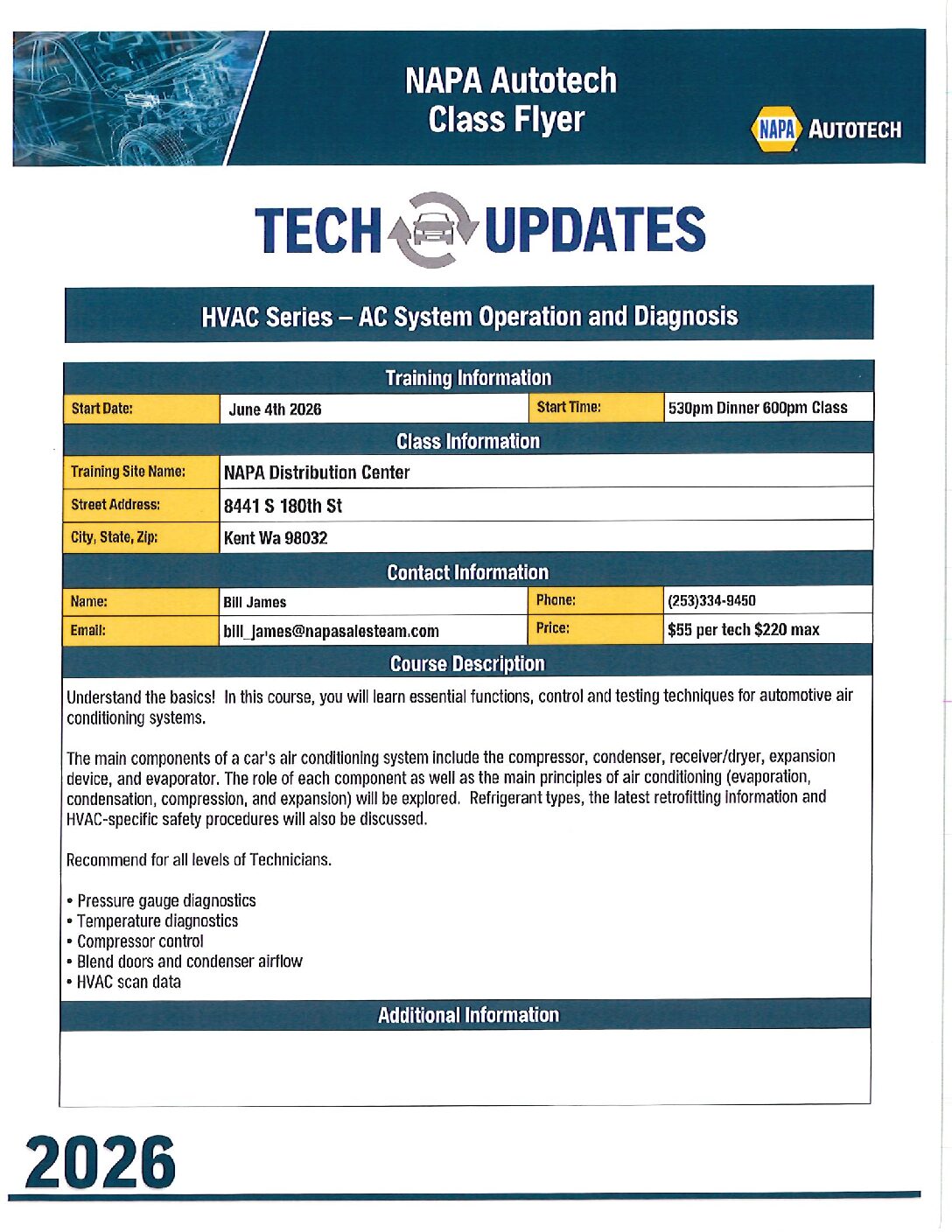
Title: HVAC Series – AC Systems Operation and Diagnosis
Date: June 4th, 2026
Time: 5:30 pm – Dinner, 6:00 pm Class
Location: NAPA Distribution Center
8441 S 180th St, Kent, WA 9832
Cost: $55.00 per tech, $220.00 max
Understand the basics! conditioning systems. In this course, you will learn essential functions, control and testing techniques for automotive air conditioning systems.
The main components of a car’s air conditioning system include the compressor, condenser, receiver/dryer, expansion device, and evaporator. The role of each component as well as the main principles of air conditioning (evaporation, condensation, compression, and expansion) will be explored. Refrigerant types, the latest retrofitting information and HVAC-specific safety procedures will also be discussed.
Recommend for all levels of Technicians.
- Pressure gauge diagnostics
- Temperature diagnostics
- Compressor controled
- Blend doors and condenser airflow
- HVAC scan data
NAPA AUTOTECH – Tech Updates
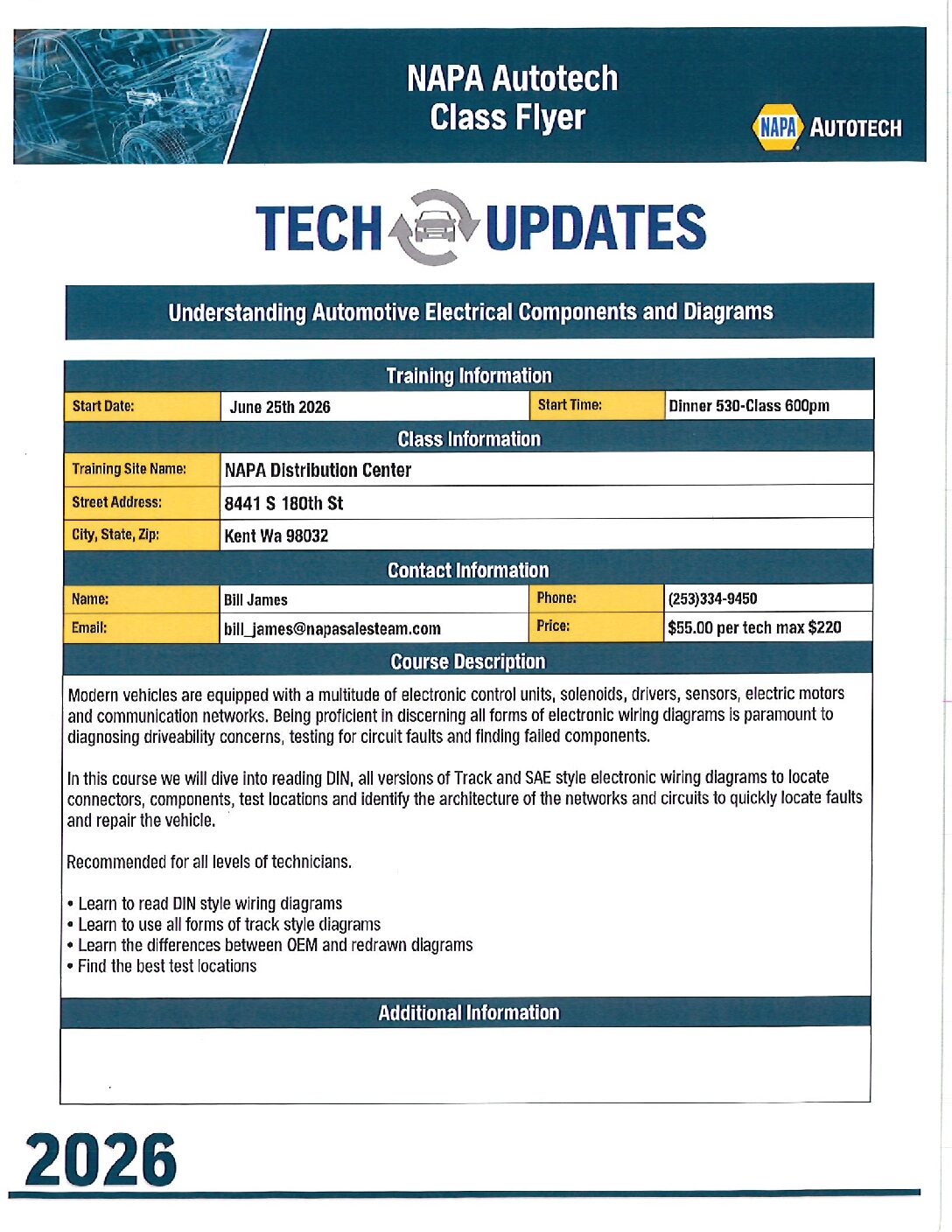
Title: Understanding Automotive Electrical Components and Diagrams
Date: June 25th, 2026
Time: 5:30 pm – Dinner, 6:00 pm Class
Location: NAPA Distribution Center
8441 S 180th St, Kent, WA 9832
Cost: $55.00 per tech, $220.00 max
Modern vehicles are equipped with a multitude of electronic control units, solenoids, drivers, sensors, electric motors, and communication networks. Being proficient in discerning all forms of electronic wiring diagrams is paramount to diagnosing driveability concerns, testing for circuit faults, and finding failed components.
In this course, we will dive into reading DIN, all versions of Track and SAE style electronic wiring diagrams to locate connectors, components, test locations and identify the architecture of the networks and circuits to quickly locate faults |and repair the vehicle.
Recommended for all levels of technicians.
- Learn to read DIN style wiring diagrams
- Learn to use all forms of track style diagrams
- Learn the differences between OEM and redrawn diagrams
- Find the best test location
NAPA AUTOTECH – Tech Updates
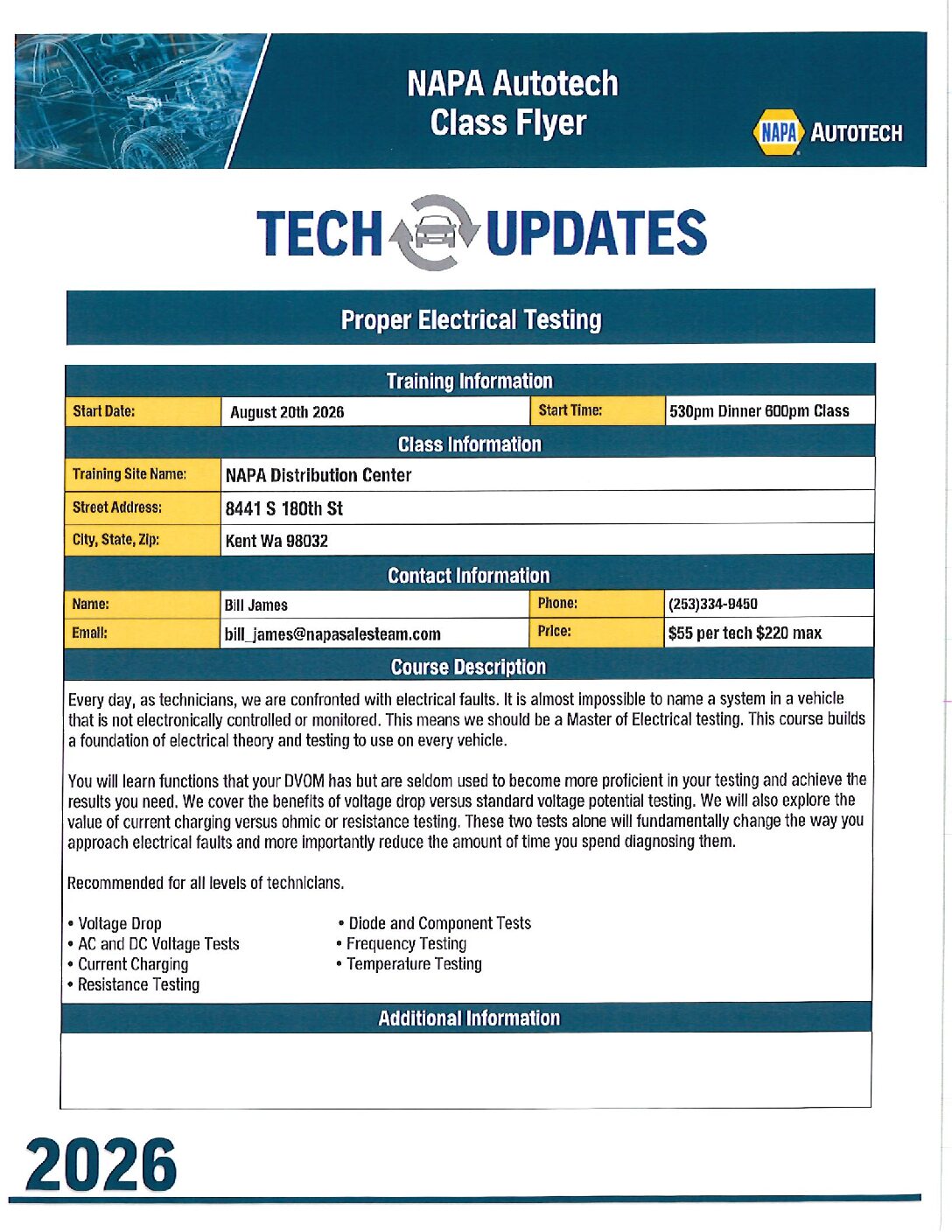
Title: Proper Electrical Testing
Date: August 20th, 2026
Time: 5:30 pm – Dinner, 6:00 pm Class
Location: NAPA Distribution Center
8441 S 180th St, Kent, WA 9832
Cost: $55.00 per tech, $220.00 max
Every day, as technicians, we are confronted with electrical faults. It is almost impossible to name a system in a vehicle that is not electronically controlled or monitored. This means we should be a Master of Electrical testing. This course builds | a foundation of electrical theory and testing to use on every vehicle.
You will learn functions that your DVOM has but are seldom used to become more proficient in your testing and achieve the results you need. We cover the benefits of voltage drop versus standard voltage potential testing. We willalso explore the value of current charging versus ohmic or resistance testing. These two tests alone will fundamentally change the way you approach electrical faults and, more importantly reduce the amount of time you spend diagnosing them.
Recommended for all levels of technicians.
- Voltage Drop
- AC and DC Voltage Tests
- Current Charging • Resistance Testing
- Diode and Component Tests
- Frequency Testing
- Temperature Testin
NAPA AUTOTECH – Tech Updates
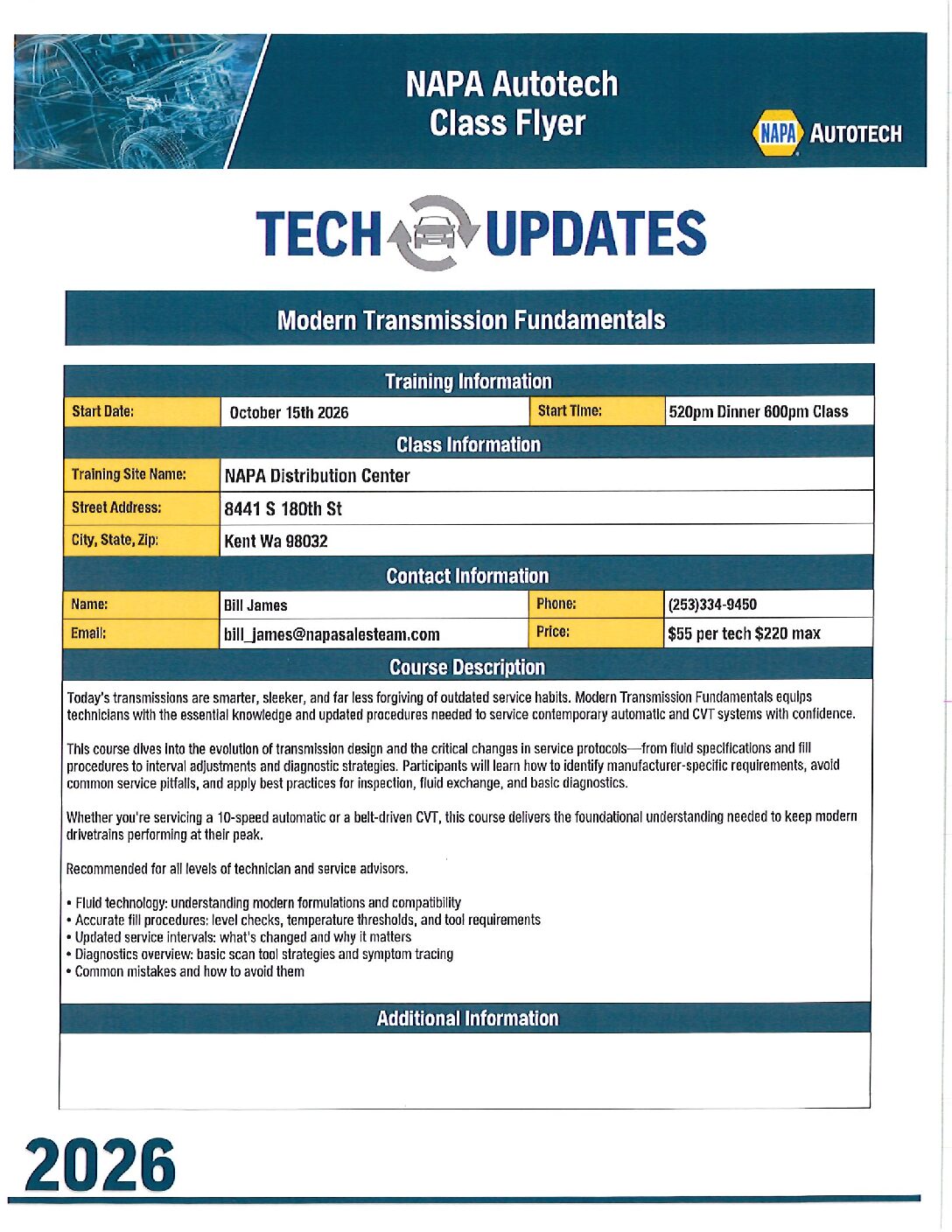
Title: Modern Transmission Fundamentals
Date: October 15th, 2026
Time: 5:30 pm – Dinner, 6:00 pm Class
Location: NAPA Distribution Center
8441 S 180th St, Kent, WA 9832
Cost: $55.00 per tech, $220.00 max
Today’s transmissions are smarter, sleeker, and far less forgiving of outdated service habits. Modern Transmission Fundamentals equips technicians with the essential knowledge and updated procedures needed to service contemporary automatic and CVT systems with confidence.
This course dives into the evolution of transmission design and the critical changes in service protocols-from fluid specifications and fill procedures to interval adjustments and diagnostic strategies. Participants will learn how to identify manufacturer-specific requirements, avoid common service pitfalls, and apply best practices for inspection, fluid exchange, and basic diagnostics.
Whether you’re servicing a 10-speed automatic or a belt-driven CVT, this course delivers the foundational understanding needed to keep modern drivetrains performing at their peak.
Recommended for all levels of technicians and service advisors.
- Fluid technology: understanding modern formulations and compatibility
- Accurate fill procedures: level checks, temperature thresholds, and tool requirements
- Updated service intervals: what’s changed and why it matters
- Diagnostics overview: basic scan tool strategies and symptom tracing
- Common mistakes and how to avoid them